
British sociologist Les Back wrote in The Art of Listening that we live in a culture where speaking outweighs listening. From reality TV to political rallies, people compete to express themselves and crave attention, reducing reality to a spectacle of performance and voyeurism. In the digital age, we can easily find countless tutorials on public speaking and personal branding, yet resources that teach us how to become better listeners are rare.
We tend to speak too much and listen too little. This lack of listening is pervasive—showing up in family conflicts, business negotiations, and even international politics. Even meetings that are supposedly designed to foster communication often devolve into a ritual of taking turns to speak. On the surface, participants appear attentive, but in reality, their minds may already be elsewhere—either bored by the topic or busy preparing their own response. We’re used to interrupting, adding our own input, offering advice, turning moments that should be about listening into warm-ups for our next monologue. When everyone in a society is focused on amplifying their own voice, the ability to truly listen becomes one of the rarest and most valuable qualities of our time.
Of course, not every viewpoint deserves our full attention, and perhaps we could do with fewer performative meetings. But when it comes to topics we’re genuinely curious about—when we sincerely want to understand others—knowing how to obtain honest, meaningful information becomes essential. Just like public speaking, listening is a skill that can be trained. It has nothing to do with being introverted or extroverted, and everything to do with learning the right strategies.
How do we cut through the noise of human communication to uncover others’ true needs and motivations?
With that question in mind, I read two books last month that, while seemingly unrelated, share a common wisdom.
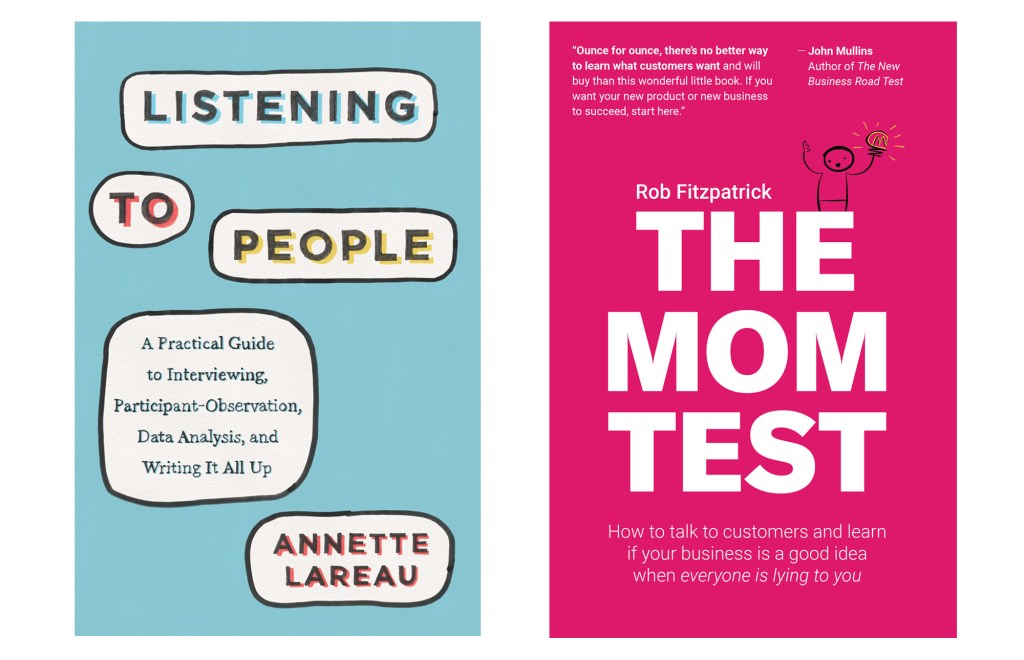
- The Mom Test by Rob Fitzpatrick is a hands-on guide for entrepreneurs and product managers on how to conduct user research. The title comes from an opening anecdote: if your mom tells you your startup idea is “great” just to avoid hurting your feelings, that kind of feedback is essentially worthless.
- Listening to People by Annette Lareau, on the other hand, is written for researchers conducting qualitative interviews and participant observation. Drawing on detailed case studies, the book offers a systematic guide through the entire process—from preparing for interviews to conducting them, and analyzing the data afterward.
Although the two books target different audiences, they share a common set of principles when it comes to the art of listening and interviewing. In both sociological research and user research, the early stages often involve talking to people when all you have is a vague idea. Asking questions like “What do you think of this product idea?” or “How do you feel about the project I quit my job to pursue?” usually leads nowhere. These are “fishing questions”—ones that reveal your intentions too early. Because people generally don’t want to hurt your feelings, they’re more likely to give you polite but ultimately misleading answers. A person might say they’d gladly pay $10 a month for your service, but when you actually ask for their credit card, they hesitate—or back out entirely.
In user research, the cost of false-positive feedback is building a product that no one actually needs. In qualitative research, shallow interview data can lead to superficial findings, making it difficult to uncover the interviewee’s real experiences and perspectives. In both cases, you’ve likely invested considerable time to gather this information—so it’s worth avoiding these pitfalls.
Even if you’re not conducting interviews as part of your work, developing strong listening skills can still make you a better partner, parent, child, or friend. In what follows, I’ll distill a few key strategies that both books repeatedly emphasize, in the hope that they can offer guidance for all kinds of situations where real listening matters.
Strategy 1: Talk Less, Listen More
The purpose of conducting an interview is that you believe the interviewee is an expert in some area, and their perspective matters. So ideally, the interviewee should be the one doing most of the talking. And yet, interviewers often find themselves unconsciously trying to steer the conversation.
In early-stage user research—when you’re approaching potential users with a startup idea—it’s easy for the enthusiastic salesperson in you to take over, turning what should be a listening session into a mini sales pitch. You might start introducing what your product can do too soon, or jump in with “No, you misunderstood, it actually can also…” the moment someone expresses doubt. These defensive responses are like pressing the mute button just as the other person is about to open up.

In qualitative research, while there’s no obvious urge to sell, interviewers still face two common forms of interference:
- The pressure of knowledge symmetry: when the interviewee flips the question and asks, “What do you think about this?”
- The anxiety of silence: the instinct to fill the space when a pause occurs
In the first case, it’s fine to give a brief response, but make it clear that you don’t want to take up too much of their time, and would rather hear more of their thoughts. As for silence, it should be welcomed, not feared. Silence can be a form of inquiry too, a shared moment of tension that invites reflection. During those pauses, interviewees might be gathering their thoughts or deciding whether to go deeper. Jumping in too quickly can mean missing out on more meaningful answers.
Strategy 2: Center the Interviewee’s Perspective — Let Go of Assumptions, Hear What’s Real
We often hear what we want to hear in an interview, rather than what we need to hear. A common mistake is asking leading questions—ones that carry assumptions or imply causal relationships within the question itself. For example:
- “What are the inconveniences of living in this community?” (assumes such inconveniences exist)
- “Do you think growing up in a working-class family affected your worldview?” (assumes there was an effect)
- “A lot of people say X is a hassle—what do you think?” (invokes peer pressure)
If you look closely, you’ll notice that all of these are yes/no questions. While you could follow up to get more details (see Strategy 3), these types of questions carry other risks. If your assumptions don’t match the interviewee’s experience, they may feel judged or misunderstood, leading them to become defensive. Others might go along with your suggestion just to be polite—even if that’s not how they actually feel.
Better questions are usually more open-ended, such as:
- “Can you tell me about what you did yesterday?”
- “Could you share a bit about your family growing up?”
- “Some people have told me X, others said Y. What’s it like for you?”
Sometimes, to show we’re actively listening, interviewers try to summarize what they’ve heard to confirm their understanding. While this may sound mechanical—like a copy-paste exercise (“mirroring technique”)—it actually helps avoid the distortions that often happen when we paraphrase. When reflecting back, aim to stay as close as possible to the interviewee’s own words, rather than layering in your interpretation. Each person is the best interpreter of their own experience. As researchers, our job isn’t to impose causality, but to uncover the web of meaning people construct for themselves.
Strategy 3: Focus on Specific Events, Avoid Vague Opinions
As mentioned earlier, understanding the interviewee’s perspectives and feelings is crucial—but when questions lack concrete context, the answers often remain vague or generalized. People tend to struggle with abstract questions, just as they hesitate when filling out a Likert scale from “strongly agree” to “strongly disagree.” In quantitative research, a large sample size can help offset individual ambiguity. But in qualitative research, where sample sizes are usually smaller, it’s essential to probe for details that enrich each response.

In user research, instead of asking, “How important is this issue to you?” it’s more effective to explore how the issue shows up in the interviewee’s life. For example: “When was the last time you encountered this problem? What happened? How did you deal with it?” If the interviewee has never taken any steps to solve the problem, that might indicate it’s not actually a priority, or that a simple workaround already exists. In such cases, a product developed to address this issue may lack real market demand.
The same applies to qualitative research. Rich, detailed descriptions not only help researchers better understand their participants but also make the final report more persuasive. When readers can form their own judgments based on vivid quotes and specific context, the credibility of your research increases significantly.
Effective follow-up questions can take many forms, such as:
- “Could you be more specific?”
- “Do you recall a recent example?”
- “How did that feel for you?”
- “Can you walk me through how that situation unfolded?”
- “Did that happen yesterday/last week? Could you describe it in more detail?”
In cases involving numerical or frequency-based information—like how often something occurs or details about personal income—interviewees may start with vague terms like “often,” “rarely,” or “not much.” In those cases, you can offer choices to help them clarify:
- “Roughly how often would you say—daily, weekly, monthly?”
- “Would you say it’s under $50,000, between $50,000 and $100,000, or over $100,000?”
Follow-up doesn’t always have to be in the form of a question. Sometimes simply repeating the interviewee’s own words—especially phrases from the middle or end of their answer—can prompt them to continue:
- “You felt overwhelmed at that moment…”
- “You tried to solve it, but couldn’t find a way…”
It’s important to remember that interviewee responses may be ambiguous or packed with multiple threads. You’ll need to decide which direction to pursue. That judgment should be based on the focus of your research—if a particular detail could serve as a vivid illustration, it’s worth taking the time to dig deeper.
A useful test for whether you’ve gathered enough detail: can you mentally reconstruct the scene? Do you know when and where it happened, who was involved, how the situation unfolded, and what emotions and perspectives were present? If you had to write a case study, would the reader be able to experience the event immersively? If not, there’s probably more to ask.

At the same time, be sensitive to the interviewee’s emotional cues and body language. If they fall silent or appear hesitant, try rephrasing your question. But if they continue to resist, it’s best to change the subject. Maybe the question isn’t critical to your research, or perhaps you can piece together an answer from other parts of the conversation. Either way, the fact that they don’t want to talk about it already tells you something valuable.
Strategy 4: Build Trust and Manage the Interview’s Rhythm
An interview is not just a casual conversation—it’s more formal, with a clear purpose. Many interviewees may have never participated in a formal interview before and can feel uneasy. Even friends or acquaintances might become self-conscious in an interview setting, let alone strangers. While participants often agree to be interviewed out of goodwill, they’re not always sure what kind of information is most useful to you. Some may speak at length but wander off-topic, while others give such brief answers that follow-up questions become difficult. There’s no magic formula to ensure every interview goes smoothly, but the following strategies may help:
- Create a Relaxed Atmosphere
For early-stage user research, it may not be necessary to formally schedule a meeting. This flexibility can help you reach a wider range of potential interviewees while also reducing their nervousness. You might consider finding opportunities to ask your questions during casual encounters—at a social event, a trade fair, or during day-to-day conversations.
In qualitative research, however, this approach is harder to implement. Ethics reviews typically require you to inform participants about the research and obtain written consent in advance—a process that can make things feel stiff. One way to ease the tension is to chat informally after the formalities are complete but before the official interview begins. Talk about something light, such as an amusing detail in the environment or what you were doing earlier that day. You can also emphasize that this is a conversation, not a test—there are no right or wrong answers, and any information they share is helpful.
- Prepare a Question List—and Prioritize
Managing the rhythm of an interview requires what’s known as “dual attention”: following the interviewee’s train of thought while constantly keeping your internal “question map” in view. The Mom Test advises having three key questions memorized. For qualitative research, you’ll likely need more, but organizing them by priority is essential.

As mentioned earlier, some topics will naturally invite deeper probing. Talkative interviewees may also lead the conversation in unexpected directions. It’s okay to let the topic drift temporarily, but you can gently steer it back with transitions like: “What you just said about X is really interesting—but I’d love to return to what you mentioned earlier about Y.”
You’ll likely conduct more than just a couple of interviews. When you’ve completed about half to two-thirds of your planned interviews, it’s a good moment to step back and evaluate—are the questions and structure still serving your purpose? Adjust as needed for the remaining sessions.
- The Crucial First 15 Minutes
An interview is a process of mutual adjustment, and the first 15 minutes are especially important. Use this time to set expectations and establish the pace. While it’s common to start with simple warm-up questions, it’s still wise to look for specific details early on. If you settle for vague answers at the start, the interviewee may assume that level of detail is acceptable, and it can be hard to shift gears later.
When an interviewee shares something detailed or insightful, show your appreciation. Let them know the information is helpful. This kind of feedback not only puts them at ease but also encourages them to offer richer responses to later questions.you’ve already gathered—after all, deadlines don’t wait.
Conclusion
There’s a gap between knowing these strategies and being able to use them skillfully, and bridging that gap takes practice, often through many rounds of interviewing. Beginners may feel nervous or make mistakes. But even seasoned interviewers often finish a conversation only to realize they forgot to ask a crucial question, or notice while reviewing the recording that a follow-up could have been handled better.
Active listening, which good interviewing demands, is a mentally demanding task. You need to stay fully present, think on your feet, be professional yet personable. When the interview ends—after you’ve thanked the interviewee, saved the audio file, and written up your notes—it’s best to take a moment alone, to return to your own world and recharge.
Each of our lives is both unique and limited in scope. Some people explore the world by crossing oceans and borders; others do it by talking to people from different walks of life. Interviewing, at its core, is a kind of cognitive generosity: when someone opens up their vault of experience to us, we get to borrow their eyes and see the world through them, if only for a while. Through these conversations, we can climb mountains we may never set foot on, glimpse landscapes we may never see with our own eyes, and in doing so, expand the contours of our own understanding.
If the four strategies outlined above are a kind of toolkit, then the real source of their effectiveness lies in the mindset of the person using them. Beyond technique, what makes an interview truly meaningful is a sustained curiosity and respect for the worlds of others. Come to your conversations with genuine interest, an open mind, and empathy—and you may uncover cognitive gold buried in the most ordinary of stories.ion… even for revising those ethics forms and risk assessments.
*All images are generated by Recraft.ai
 Claire Zhuo Pang
Leave a comment